The internet has changed the way people discover businesses, compare products, and make buying decisions. A customer may find a company through Google, see its social media page, read a blog post, watch a video, and then visit its website before making a purchase. Because of this, businesses need more than a simple website. They need a clear digital marketing plan.
The digital marketing guide Gonzay.com can be viewed as a starting point for understanding how different online marketing methods work together. Digital marketing is not just about advertisements or social media posts. It involves attracting the right people, giving them useful information, earning their trust, and making it easy for them to become customers.
This guide explains the main parts of digital marketing in simple English and shows how a beginner can create a practical online marketing strategy.
What Does Digital Marketing Mean?
Digital marketing is the promotion of a business, product, service, or personal brand through internet-based channels.
These channels can include:
- Search engines
- Websites
- Blogs
- Social media
- Online advertisements
- Video platforms
- Mobile applications
Imagine a local clothing store that wants more customers. The owner could create a website, publish helpful fashion articles, optimize the website for Google, post product photos on social media, collect customer emails, and run advertisements.
All of these activities are examples of digital marketing.
The important point is that digital marketing should have a purpose. Posting content every day without knowing what you want to achieve can waste time and money.
Why Businesses Need a Digital Marketing Strategy
Having an online presence does not automatically bring customers.
A business may have a beautiful website but receive very little traffic. Another company may have thousands of social media followers but generate few sales. The difference is often the strategy behind their marketing.
A good digital marketing plan can help a business:
- Become easier to find online
- Reach a specific audience
- Build credibility
- Generate leads
- Increase sales
- Stay connected with customers
- Understand customer behavior
- Reduce wasted advertising spending
Digital marketing also gives businesses something traditional marketing often cannot provide at the same level: detailed performance information.
You can see where visitors came from, which pages they viewed, which advertisements received clicks, and which campaigns generated conversions.
Start With Your Target Customer
One of the first lessons in digital marketing is to stop trying to market to everyone.
Before creating content or buying advertisements, think about the person you want to reach.
Ask questions such as:
- What problem does this person have?
- What product or service are they looking for?
- What questions do they ask online?
- Which websites or social platforms do they use?
- What might stop them from buying?
- What information would make them trust a business?
For example, a company selling accounting software should not create the same message for a university student and a small-business owner.
The better you understand your audience, the easier it becomes to create useful content and advertisements.
SEO: Helping People Find Your Website
Search engine optimization, or SEO, is a major part of digital marketing.
SEO is the process of improving a website so search engines can understand its content and users can find useful information through search.
Google recommends creating helpful content and making websites easier for search engines to understand. You can learn more from the official Google Search Central SEO documentation.
SEO normally includes several areas.
Keyword Research
Keywords are the words and phrases people use when searching online.
For example, someone looking for marketing help might search:
- digital marketing services
- SEO company
- social media marketing
- online marketing guide
- how to improve website traffic
Good keyword research is not simply about finding keywords with high search volume. You should also consider whether the keyword matches what your business offers.
A smaller, highly relevant keyword can sometimes be more valuable than a very broad keyword.
On-Page SEO
On-page SEO involves improving individual pages.
This can include:
- Writing useful page titles
- Using clear headings
- Creating readable content
- Adding descriptive image text
- Linking related pages
- Using keywords naturally
- Writing useful meta descriptions
The goal is to make the page easy for both people and search engines to understand.
Technical SEO
Technical SEO focuses on how a website works behind the scenes.
Important areas include website speed, mobile usability, crawlability, security, redirects, and website structure.
A technically healthy website gives visitors a smoother experience and makes it easier for search engines to discover and process pages.
Content Marketing: Give People a Reason to Visit
Content marketing is about producing information that your audience actually wants.
Instead of constantly saying, “Buy our product,” a business can answer questions and solve problems.
For example, a company selling gardening products could publish:
- How to choose soil for indoor plants
- Common mistakes new gardeners make
- How often different plants need water
- A beginner’s guide to growing herbs
These articles can attract people before they are ready to purchase.
Useful content can also build authority. When readers repeatedly find helpful information from the same business, they may become more comfortable buying from that company.
Social Media Marketing
Social media allows businesses to communicate directly with potential customers.
However, every platform does not suit every business.
A company should first decide where its audience spends time. Then it can create content specifically for that platform.
Social media content might include:
- Short educational videos
- Product demonstrations
- Customer stories
- Behind-the-scenes posts
- Questions and polls
- Industry tips
- Infographics
- Announcements
Consistency matters, but quality is more important than simply posting many times.
A useful post that answers a customer’s question can be more valuable than several posts that contain little information.
Email Marketing and Customer Relationships
Email marketing is useful because it allows a business to communicate with people who have already shown interest.
A company can build an email list by offering something useful, such as a free guide, discount, checklist, or newsletter.
After someone joins the list, the business can send relevant messages.
For example:
Email 1: Welcome message
Email 2: Helpful information
Email 3: Product or service explanation
Email 4: Customer example or case study
Email 5: Special offer
The purpose should not be to fill people’s inboxes. Emails should provide a reason for subscribers to open and read them.
Paid Advertising Can Speed Up Results
Organic marketing methods such as SEO can take time. Paid advertising can help a business reach potential customers more quickly.
Popular forms of paid advertising include search ads, social media ads, display advertising, shopping ads, and remarketing.
However, paying for traffic does not guarantee success.
Before launching an advertising campaign, decide:
- Who should see the advertisement?
- What action should they take?
- Where will they go after clicking?
- How much can you afford to spend?
- How will you measure the result?
A poor landing page can waste money even when an advertisement receives many clicks.
Your Website Is the Center of Your Strategy
Social media platforms are useful, but a business should not depend entirely on them.
Algorithms and platform rules can change. Your website gives you more control over your brand and customer experience.
A strong website should make the following information easy to find:
- What the business does
- Who it helps
- What products or services it offers
- Why customers should trust it
- How to contact the business
- What action visitors should take next
The website should also be easy to use on smartphones.
If visitors cannot quickly understand the page or find what they need, they may leave before becoming customers.
Measure More Than Website Traffic
Traffic is useful, but it is not the final goal.
Suppose Website A receives 20,000 visitors and produces 50 sales. Website B receives 5,000 visitors and produces 150 sales.
Website B has less traffic but may be doing a much better job of attracting the right audience.
Useful digital marketing measurements include:
- Organic visitors
- Leads
- Sales
- Conversion rate
- Cost per lead
- Advertising cost
- Email clicks
- Social engagement
- Revenue from campaigns
Google’s search documentation and related tools can help website owners understand how their pages appear in search and identify areas for improvement.
Build a Simple Digital Marketing Funnel
A useful way to organize online marketing is to think about the customer journey.
Stage 1: Awareness
The person discovers your business.
SEO, social media, videos, and advertisements can help at this stage.
Stage 2: Interest
The person wants to learn more.
Helpful articles, product pages, guides, reviews, and videos can answer their questions.
Stage 3: Consideration
The potential customer compares your offer with other choices.
This is where testimonials, demonstrations, case studies, pricing information, and clear benefits can help.
Stage 4: Conversion
The person becomes a customer.
A simple checkout process, contact form, booking system, or clear call-to-action can make this step easier.
Stage 5: Retention
Marketing should not end after the first purchase.
Email campaigns, helpful content, customer support, loyalty programs, and personalized offers can encourage repeat business.
How Beginners Can Start Digital Marketing
You do not need a large team to begin.
Start with five basic actions.
1. Choose One Business Goal
For example, aim to generate more leads or increase online sales.
2. Identify One Main Audience
Understand their problems and online behavior.
3. Improve Your Website
Make important pages clear, useful, fast, and mobile-friendly.
4. Create Helpful Content
Publish information that answers questions your potential customers are already asking.
5. Track Your Progress
Look at your traffic, leads, conversions, and sales. Keep the strategies that produce useful results and improve the ones that do not.
The Role of AI in Modern Digital Marketing
Artificial intelligence is becoming another useful tool for marketers.
AI can help with brainstorming, customer research, content planning, data analysis, automation, and personalization.
For example, a marketer can use AI to generate ideas for blog topics and then improve those ideas with human research and experience.
The important thing is not to publish large amounts of low-quality material simply because AI can create it quickly. Readers still need accurate, original, useful information.
Human review remains important for facts, tone, originality, and customer understanding.
Common Digital Marketing Mistakes to Avoid
Many businesses make avoidable mistakes when starting online marketing.
Using Too Many Channels
Trying to manage every social platform at once can spread your resources too thin.
Ignoring Search Intent
A keyword may have many searches but still be unsuitable for your business.
Writing Only for Search Engines
Content should satisfy people first. Keywords should fit naturally into useful information.
Forgetting Existing Customers
Finding a new customer can be harder than keeping a satisfied customer engaged.
Making Decisions Without Data
Do not continue spending money on a campaign simply because it “looks good.” Check the actual results.
Final Thoughts on the Digital Marketing Guide Gonzay.com
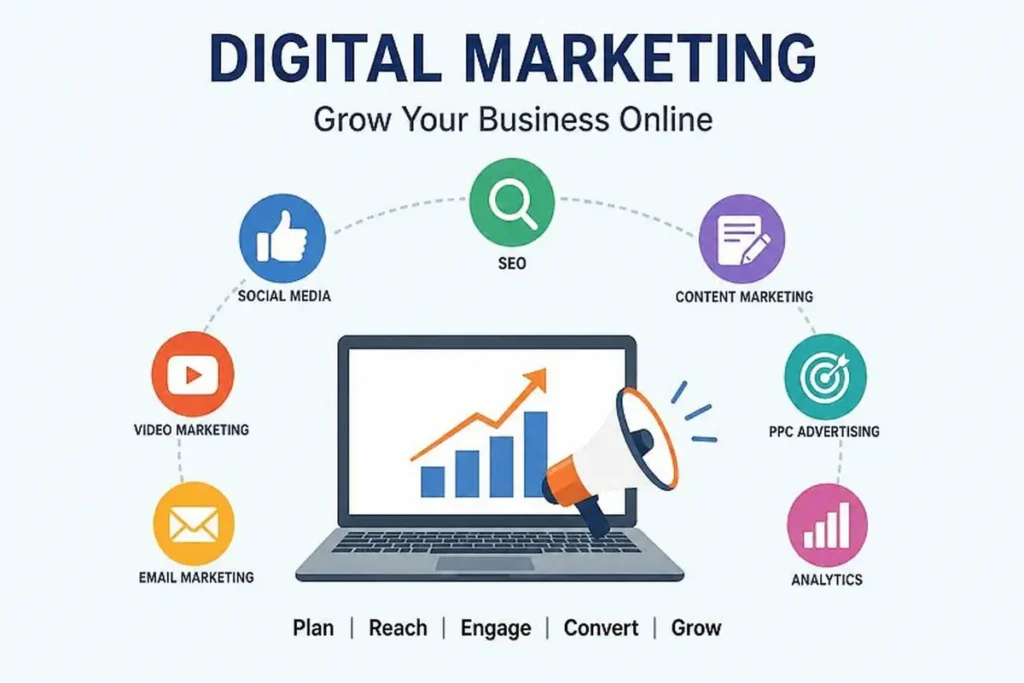
The digital marketing guide Gonzay.com can be approached as a broader lesson in how different online channels work together. Gonzay’s digital marketing material covers areas such as SEO, content, social media, email, PPC, and analytics.
The most important lesson is that digital marketing is not one single activity. SEO can bring people to your website. Content can educate them. Social media can create awareness. Email can maintain the relationship. Paid advertising can provide additional reach. Analytics can show whether the entire system is producing results.
A business does not need to master everything on its first day. Start with a clear audience, one measurable goal, a useful website, and valuable content. Then test different channels and use real performance data to decide where to invest more time and money.
Digital marketing becomes much easier when it is treated as a continuous process rather than a one-time campaign. Learn what your audience needs, give them useful information, measure what happens, and improve your approach step by step. That simple cycle—understand, create, promote, measure, and improve—can become the foundation of a strong long-term digital marketing strategy.